Household appliances · design, manufacturing & software
HIL test bench for household appliances: rack modules and test framework
Our own 19-inch rack modules for power supply and control, a Python test framework and operator software – proven in around 200 test runs of 1,000 tests each.
- HIL test bench
- 19-inch rack modules
- Python / pytest
- OPC UA
- CODESYS V3
- Raspberry Pi / PiXtend
- Instrumentation
Challenge
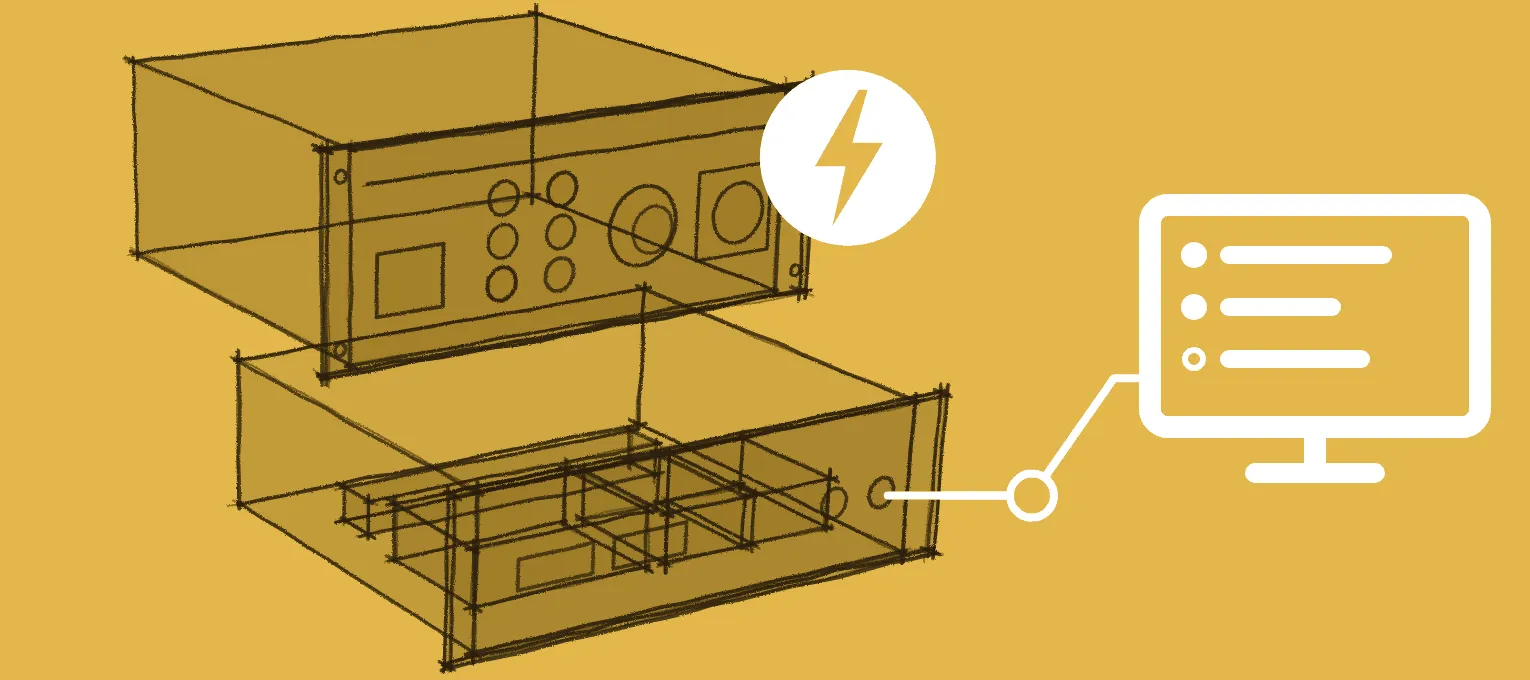
A client in the household appliance industry wanted to test its appliances automatically on a HIL test bench. The whole chain was required: a power supply with measurement, a controller that operates the appliance and injects faults in a targeted way, a test framework for the automated tests – and a user interface where testers can operate the bench and follow running tests.
Approach
We designed and built both 19-inch rack modules, developed the test framework and implemented the automated tests.
Power supply unit (PSU)
- Mains inlet via CEE connector; outlets for the device under test at 400 V / 10 A and 230 V / 16 A plus an additional 230 V socket
- 5 V / 5 A and 24 V / 5 A supply for the test bench, with fuses accessible from the outside
- Power measurement with a Finder three-phase energy meter connected to the controller via RS485 – the test framework receives the readings via OPC UA
- The software switches the device under test on and off, for example for power-cycling tests; it is disconnected from the mains with full isolation
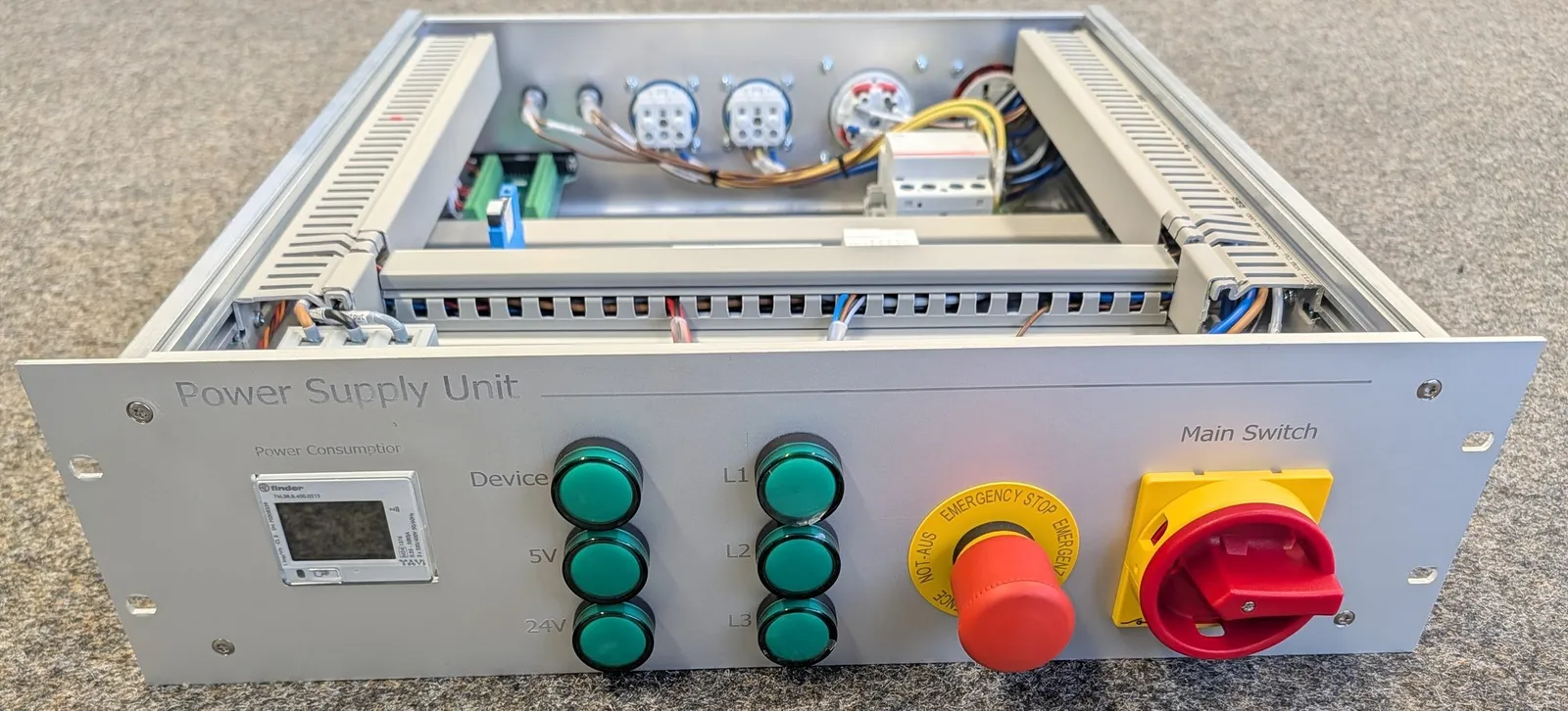
- Indicator lights for the device supply, 5 V, 24 V and the three phases, plus emergency stop and main switch
Control unit
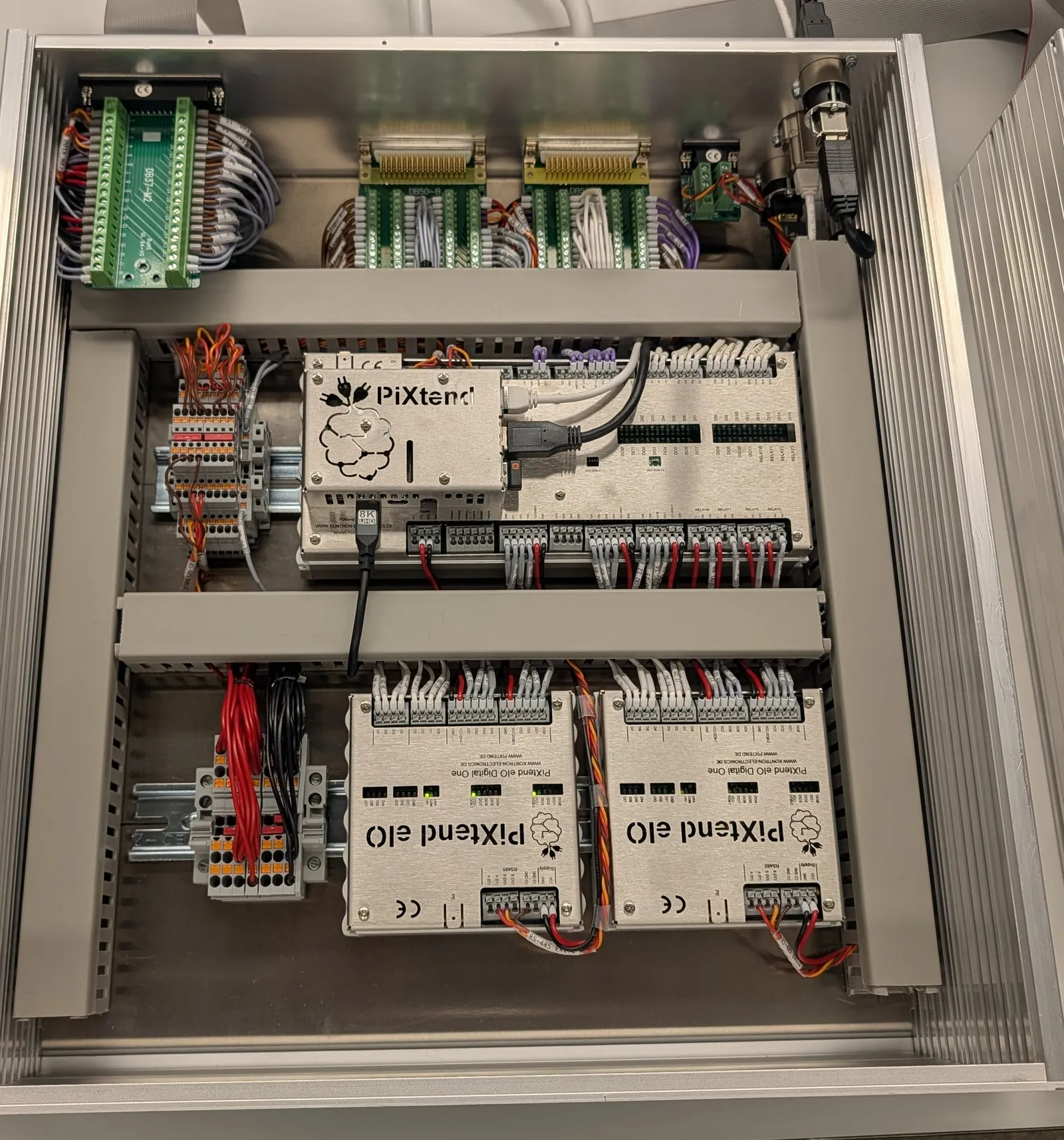
- 32 digital 24 V inputs and outputs based on a compact CODESYS controller (Raspberry Pi with PiXtend modules)
- The inputs and outputs operate the appliance during the test and inject faults in a targeted way
- Clear wiring via terminal blocks, signals handed over via D-sub connectors
Test framework and operator software
- Test framework written entirely in Python, built on pytest
- Operator software for Windows, also in Python: testers operate the bench directly and follow automated tests while they run
- Modular architecture – further function modules can be added easily, for example our camera module for LED detection
- Communication between software and rack modules via OPC UA
Outcome
- More than 50 % cheaper than a solution built from off-the-shelf components
- Proven in continuous operation: around 200 test runs of roughly 1,000 tests each; one test run currently takes about 18 hours
- Errors visible immediately: the user interface shows live how the automated tests are progressing. Errors or unexpected system behaviour stand out immediately and can be fixed quickly.
- Everything from one source: mechanical design, manufacturing, test framework and automated tests from a single point of contact
HIL, thought through end to end
Our solutions do not stop at the hardware of a HIL test bench. We think about HIL as a whole – from the testers’ point of view and with the needs of the organisation in mind.
More about our HIL test benches and test automation.
From the project
Click a photo to enlarge it.
-
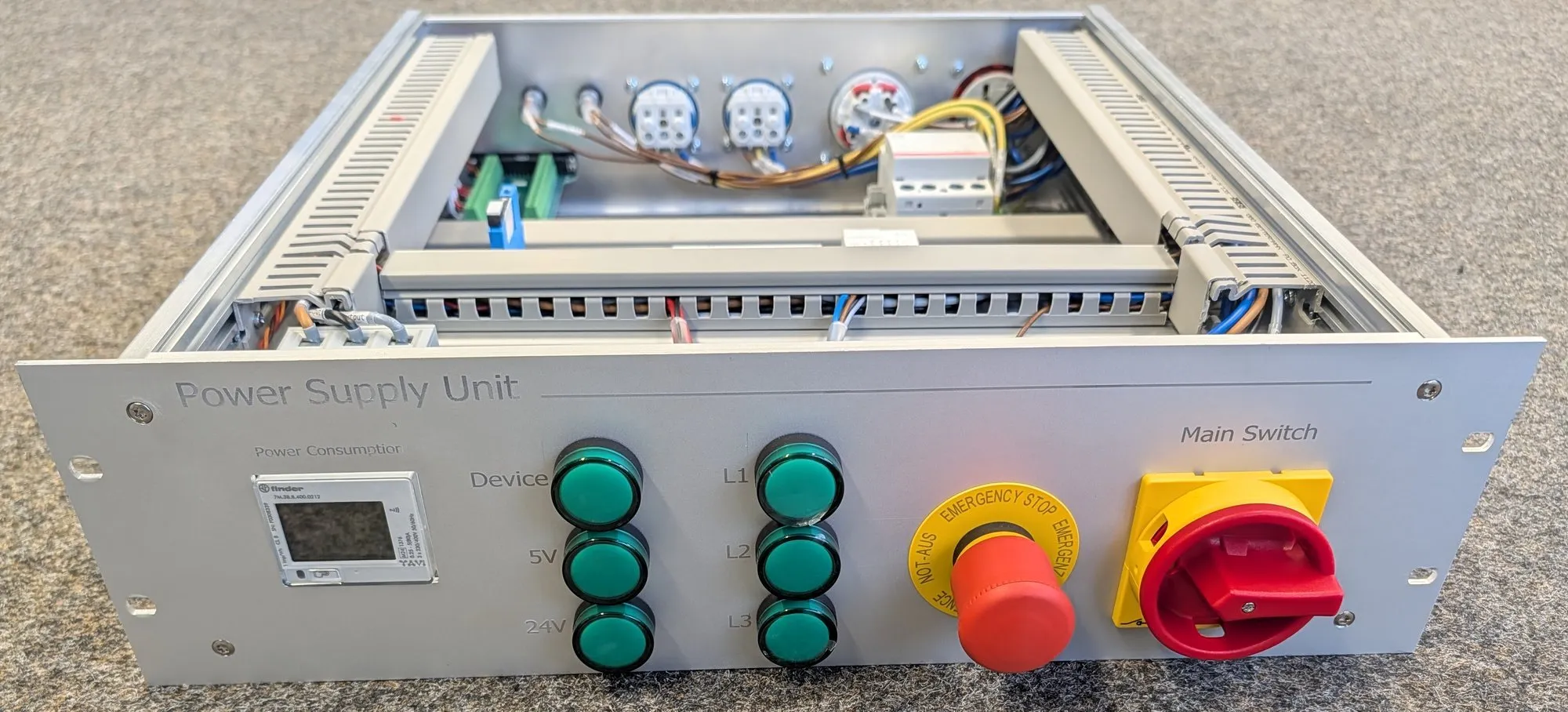
Power supply unit: power meter, indicator lights, emergency stop and main switch in the front panel -
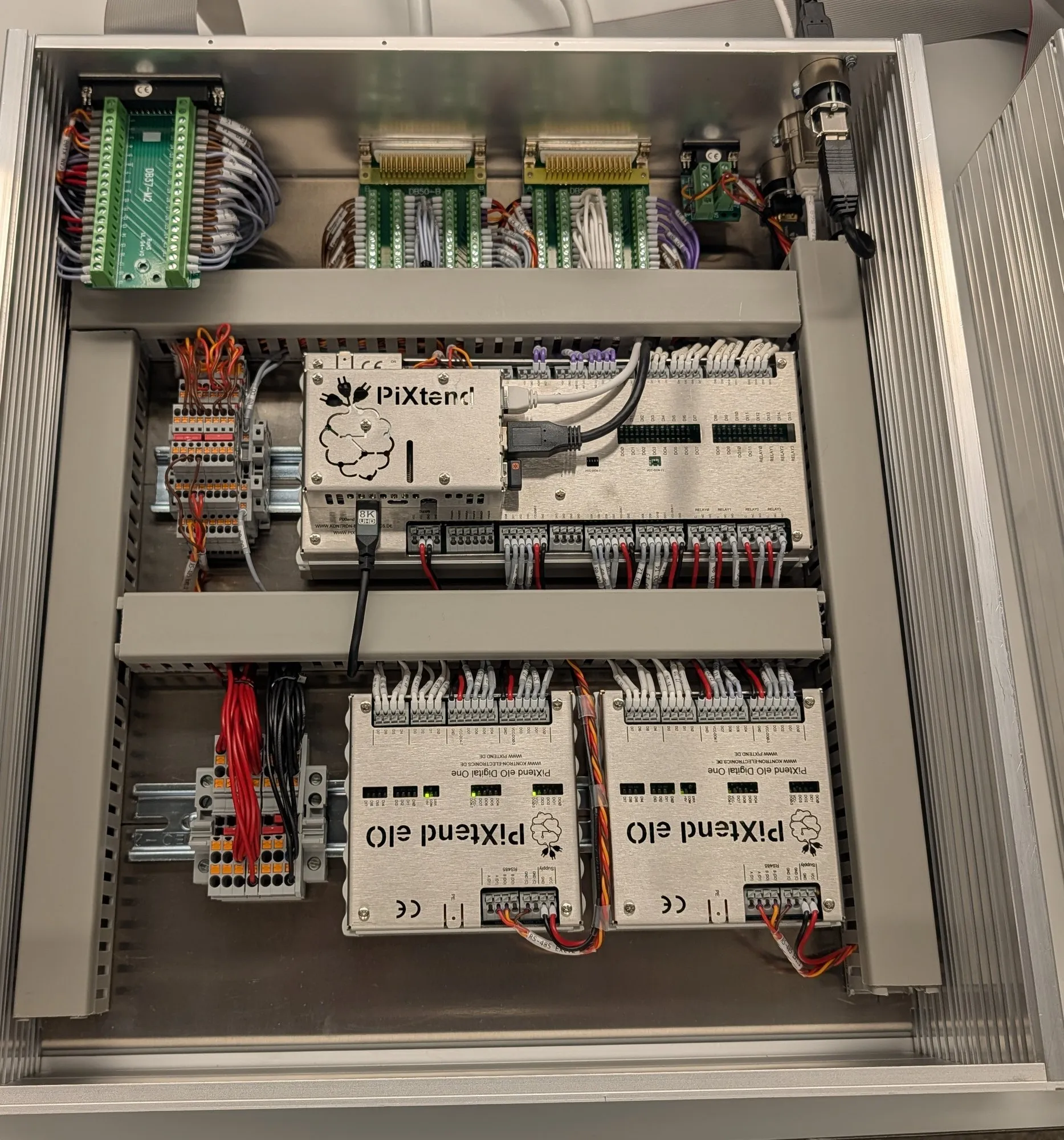
Control unit in operation: CODESYS controller, I/O modules and signal hand-over via D-sub connectors
Frequently asked questions
Why custom rack modules instead of off-the-shelf components?
In this project, costs were more than 50 % lower than a solution built from off-the-shelf components. The modules are also tailored exactly to the interfaces the test bench needs.
Which devices can the power supply unit feed?
The PSU provides outlets with 400 V / 10 A and 230 V / 16 A, plus 5 V / 5 A and 24 V / 5 A for the test bench. In this project the devices under test are household appliances – in principle the setup suits mains-powered devices within these limits.
Can the rack modules be used for other test benches?
Yes, the modules can be transferred to other projects. In the medium term we plan an online shop where you can configure your own rack module at a fixed price.
How long did the project take?
Around one year – including mechanical design, manufacturing, the test framework and the automated tests.